The year is 1822. Extravagant King George IV had only been on the
throne for two years following the death of his father George III. His
‘Grand Designs’ project, the Brighton Pavilion, was very near
completion and Queen Victoria, his niece, was just three years old.
The total population of England, Scotland and Wales was only 14.4
million; indeed, the world population was only 1 Billion (an eighth
of what it is now). The Crimean War wouldn’t even be fought for
another 31 years - Florence Nightingale was two. In the Americas,
William Richardson became the earliest Anglo inhabitant of Yerba Buena
(early San Francisco). It had only been claimed by the Spanish 43
years previously and was just a trading bay.
That very same year a group of
evangelical Christians, under the leadership of Rev George Mottram
from the Countess of Huntingdon Church (now the Zion Baptist Church)
in East Grinstead, arrived on what was part of the old Copthorne
Common in Snowhill. Since there were no chapels or churches, within
easy travelling distance to serve this area of Felbridge, they met
with no opposition and conducted their first meetings in a barn in
what became known as Chapel Lane. Five years later, on 13th June 1827,
the first stone of the current chapel building was laid and was
completed within two months, at a cost of £300 (only £33,781.53 at
today’s prices) all paid for by the legacy of Dr Ford. Selina
Hastings, the Countess of Huntingdon, had died 31 years previously in
1791.
The new Copthorne
Chapel building was opened on 5th September 1827, the first sermon
preached there by Rev J Finley, and by 1848 the congregation had grown
substantially along with a Sunday School for the children. The
Religious Census of 1851 shows the chapel as having a membership of
230.
In 1860 the
minister for the chapel was Rev George Vince who was also in charge of
the other local Countess of Huntingdon Connexion chapels of West
Hoathly (opened in 1824) and Turners Hill, (opened in 1823) and he
relied on lay-preachers to take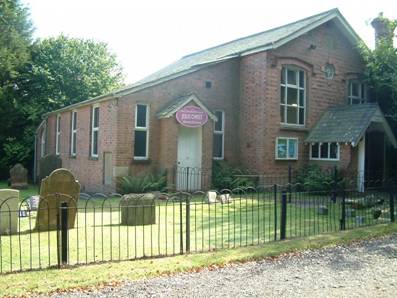 the services in his absence.
The Band of Hope,
a temperance organisation founded in Leeds to teach children the
importance and principles of sobriety and teetotalism, was started at
the chapel in 1887 and soon became part of the community, with some 50
children and 10 adults joining, and by 1898 a photograph records a
group of around 186 people.
The growth in the membership appeared to
have had some benefit for the chapel, and in 1890 a further room was
added. The chapel itself was then restored between 1896 and 1898, with
new seats and facings being put in and the old brickwork replaced. In
the second half of the 20th century the reinforced floor, originally
laid to take the weight of a portable baptism pool, had to be
replaced, as it, and the original pulpit and pews, were destroyed by
woodworm.
The end of the
19th century and beginning of the 20th century saw the chapel at its
peak, with a gradual decline in attendance, due in part to the
building of St John’s at Copthorne and the village moved around the
church. During the 1960s the Copthorne Bank Free Church amalgamated
with the chapel which has helped to maintain its survival into the
21st century.
Its future remains
tied up with the Connexion’s network of 22 chapels in the UK and more
than 30 chapels in Sierra Leone, as well as some 20 schools. The work
in partnership with Sierra Leone is of immense value, ranging from
supplying Christmas shoebags for the children in the schools and
churches there, and in helping support infrastructure and medical
facilities. And not without good reason. The child and infant
mortality rate in England and Wales in 2018 was 3.8 per 1,000; in
Sierra Leone it was 78 per 1,000. In the area, sixty percent of the
population live below the poverty line and 1 in 3 people do not have
access to clean water.
On July 9th this year, the
current fellowship celebrated the anniversary of the chapel’s founding,
all those 200 years ago. The event clearly was a great success, with
standing room only. A trio from Crawley Baptist Church sang and Rev
Ian Phillips spoke to those there from John 21. Visitors came from
other churches and enjoyed the tea and a celebratory cake.
With so much to witness, it is intriguing to imagine the sermons from
years gone by and how they may have related to world events that have
taken place. Although the chapel is a piece of history it is also
heartening to see that, as part of the Connexion, it still has a place
in modern life and, on a Sunday morning at 10.30, still offers a
welcome to everyone to come and worship Jesus Christ as Lord.
Updated by Pastor Gordon Hamilton, July 2022
